Two tables, one world
A mine is coming to the valley. At one table, the community decides what to defend. At the other, the company decides what to offer. Five rounds later, the world tells both sides what their choices cost.
Designed by mediator and lawyer Thomas Gaultier from his fieldwork in community-company disputes, for classrooms, training rooms and workshops.
PLAYED IN ENGLISH · FRANÇAIS · PORTUGUÊS · ESPAÑOL
Watch the game before you play it
Four minutes through the real interface: the valley, the two tables, how a round is decided and locked, and what the debrief report gives you at the end.
Navigating the Accord · mechanics and interface. The narration is in English. The game itself is played in English, French, Portuguese or Spanish.
Play it yourself, free
Not a trailer, not a cut-down sample: the whole game. All five rounds, both tables, and the same debrief report a paying cohort receives. You take the community or the company side and an AI counterpart takes the other. One free game per visitor, then a key.
After that, €49 a key: replays, both sides, and twelve practitioner documents. Pricing
Run it with a group
A game key sets up one session: you choose the size of your cohort, the language, the pace and your facilitator password, and you get a single game code to give the room. Fourteen players fill one world, and one session seats up to 56: four worlds of seven and seven, played side by side and compared in the debrief. Past 56, take a second key and run two games.
€25 per seat · see what a facilitator gets
No key yet? Ask me for one.
Playing in someone's session
Your facilitator gives you a five-letter game code, and your table its own code. Pick your character once, choose a password, and that password brings you back to your table and your character from any device.
Sent a link by your facilitator? Tap it instead — it carries the codes for you.
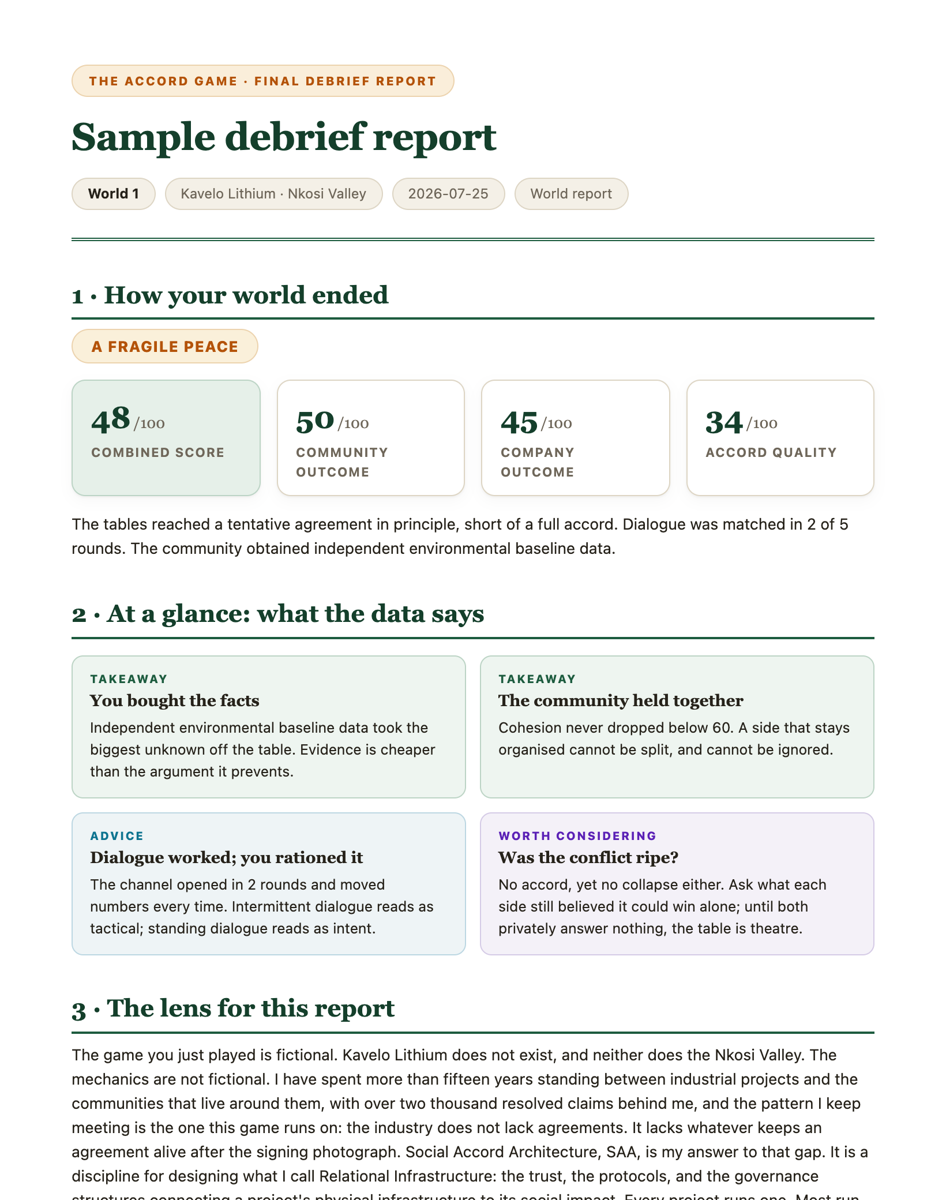
The debrief report
Each world gets its own report, and in a course each player gets a personal edition. It is generated from the event log, so the same link reproduces the same report next term, and it prints to PDF from the browser.
- How the world ended, scored out of 100 on both sides and on the accord itself
- At a glance: what the data says, in plain findings rather than numbers
- The story of the five rounds, and what the numbers did underneath it
- Perception against reality: how the room felt, set beside what was true
- What worked and what to do differently, matched to the Social Accord Architecture
How a session runs
One facilitator, one game code, and a room split into tables that never quite know what the other side is carrying.
Open a session
The facilitator turns a game key into a session and shares a single five-letter code with the room.
Sit at your table
Fourteen characters fill one world: seven at the community table, seven at the company table. A cohort of up to 56 runs four worlds in parallel from one console.
Play five rounds
Budgets, promises, protests, agreements. Each round the world scores what both tables actually did, not what they said.
Debrief together
The report puts both stories side by side: what each table saw, feared and traded away. That conversation is the point.
What the game teaches
Most negotiation exercises put everyone in the same room with the same brief. The Accord Game does the opposite: the community and the company play the same two years at separate tables, in the same world, and the world reacts to both. Trust rises and falls. Grievances pile up or get answered. An agreement signed in round three can unravel in round five because of something the other table did in round two.
The result is the closest a classroom gets to the real dynamic of a contested project: partial information, internal disagreement at your own table, and a counterpart whose behavior only makes sense at the debrief.
Where it is played
- Negotiation and mediation courses
- Community relations and social performance teams
- ESG and sustainability training
- Executive workshops on social risk
- Conference sessions and masterclasses
Sessions run in a room, online together, or fully remote. Rounds can pace from 30 minutes to a week for async course play.
Get the field notes
Occasional emails on mediating conflict between communities and companies: new tools, book releases and how facilitators are running the game. No spam, unsubscribe anytime.